Crime at 17:10 p.m. Report on the Attacks by the Israeli Zionist Regime and the United States on Lamerd Stadium (February 28 2026)
On February 28 2026 (9 Esfand 1404) during joint attacks by the United States and the Israeli Zionist regime against the Islamic Republic of Iran the Lamerd Stadium in Fars province and its surrounding areas were targeted by four new generation PrSM missiles. Due to the nature of the weapon and the time of impact (during peak daytime hours) these attacks resulted in the martyrdom of at least 21 civilians including child athletes and injured 170 others. The effects resulting from the airburst explosion of the missile and the dispersal of 180000 Tungsten fragments across various locations including the children’s sports hall residential areas and other city centers all indicate the deployment of a new missile known as PrSM. According to the rules of international law the deployment of this antipersonnel weapon in residential areas is a flagrant violation of the principles of distinction proportionality and precaution and constitutes a deprivation of individuals right to life. Based on Article 8 of the Rome Statute it is considered an overt war crime.
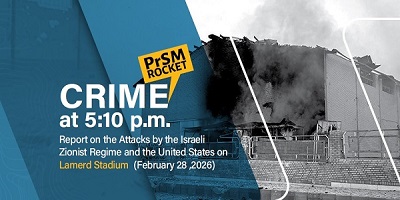
On February 28, 2026 (9 Esfand 1404), during joint attacks by the United States and the Israeli Zionist regime against the Islamic Republic of Iran, the Lamerd Stadium in Fars province and its surrounding areas were targeted by four new generation PrSM missiles. Due to the nature of the weapon and the time of impact (during peak daytime hours), these attacks resulted in the martyrdom of at least 21 civilians, including child athletes, and injured 170 others. The effects resulting from the airburst explosion of the missile and the dispersal of 180,000 Tungsten fragments across various locations, including the children’s sports hall, residential areas, and other city centers, all indicate the deployment of a new missile known as PrSM. According to the rules of international law, the deployment of this antipersonnel weapon in residential areas is a flagrant violation of the principles of distinction, proportionality, and precaution, and constitutes a deprivation of individuals, right to life. Based on Article 8 of the Rome Statute, it is considered an overt war crime.
The city of Lamerd, located in the south of Fars Province, is a civilian city with a predominantly residential, commercial, and recreational structure. The attacks on Lamerd Stadium occurred during the middle hours of the day (around 17:10), at a time when it was filled with members of youth and children’s sports teams, and the surrounding streets also had a relatively high population due to the normal movement of citizens. This crime demonstrates a blatant disregard for the principle of precaution in attacks and indicates that were deliberate on the part of America.
The PrSM missile, manufactured by Lockheed Martin, was designed as the successor to the older generation of ATACMS missiles. The critical point is that this short-range ballistic missile was utilized for the very first time in a real battlefield setting during the recent aggression against Iran. According to a report by the United States Central Command (CENTCOM), the launching of the PrSM missiles was carried out during the initial hours of the operation against Iran, and the U.S. military referred to this event as a historic milestone and proof of an unmatched deep-strike capability. The use of a weapon that had never before been tested in real combat conditions within the residential and recreational fabric of the city of Lamerd resulted in extensive civilian casualties. This was a risk that the Pentagon knowingly accepted, and its consequence unfolded catastrophically in Lamerd.
Air-burst Technology
In the investigations conducted in the residential areas and Lamerd Stadium, no trace of deep craters caused by explosion or complete collapse of structures was observed, and the only visible destruction was a very small hole with a diameter of less than 50 cm in the corner of the building’s roof. This is while missile attacks or bombings always create extensive physical destruction; however, in Lamerd, the structural damage was very low, but the human casualties were very high, a pattern that precisely matches the technical characteristics of the PrSM missile.
Unlike traditional ballistic missiles that rely on warhead mass and heavy blast upon impact, the PrSM missile is equipped with a radar proximity fuse that measures its distance to the ground or the roof of buildings with millimeter accuracy. This fuse is activated at an optimal altitude (usually between 20 and 50 meters above ground level), and the missile explodes in mid-air before physical impact with the target. This mechanism offers a significant logistical advantage for militaries: the explosive energy, instead of being absorbed into the soil or concrete, is completely released into the atmosphere, inflicting maximum damage on soft targets such as personnel and unarmored equipment.
Rain of Deadly Pellets (Anti-personnel Blast)
The PrSM missile is not designed for the physical destruction of buildings, but rather explodes in mid-air just before physical impact with the target. According to the manufacturer›s documents, upon exploding in the air, the PrSM missile hurls a wave consisting of 180,000 pre-formed fragments with high speed and intensity in all directions. These fragments are typically made of tungsten or hardened steel and have a geometric shape (often rectangular cuboid or spherical) that generates the highest penetration coefficient. The speed of these pellets at the moment of explosion reaches Mach 5 to 7 (over 6,000 kilometers per hour), which carries immense kinetic energy.
Although this technology does not leave severe structural damage behind, its pellets easily penetrate plaster and brick walls, double-glazed windows, vehicle bodies, and even thin concrete walls, effectively turning into a highly ruthless anti-personnel weapon. The traces left behind by the missile strikes in Lamerd fully confirm that the missiles exploded in the air before reaching the ground and directed a rain of shrapnel. In this missile, first, a small point of light is seen in the sky moving at high speed toward the ground. Then, suddenly a flash of intense light (resulting from the initial explosion) occurs in mid-air, immediately followed by the sound of the explosion and then the sound of thousands of fragments striking various surfaces. The main body of the missile never reaches the ground, and no trace of it is found. The critical point regarding this missile is its targeting of humans and causing human casualties on a high scale.
Forensic Signature and Sieve Effect
In Lamerd, in a section of a residential street (on Amiri Street), at least 2,000 pellet impact points were counted on the asphalt ground, the bodies of parked passenger cars, and a local fuel tanker (Tohid Tanker). These impact points have diameters between 5 and 15 mm and are scattered at intervals of a few centimeters from one another.
Additionally, 700 impact points were created on the walls of a row of residential houses. Signs of local businesses, including a beauty salon (Arayeshgah-e Aroos-e Shargh), a real estate agency (Amlak-e Shirdel), and a travel agency, were also distinctly riddled with holes. In some cases, the pellets passed through one wall, then went through the adjacent wall, and embedded themselves into a third wall.
This pattern, which in military and forensic terms is called the «Sieve Effect» or Pockmark Pattern, is an exclusive feature of the PrSM missile and perfectly matches the official promotional animations of Lockheed Martin and field reports from other deployments of this missile (such as Gaza).
Review of the Potential Objectives of the Crime
All evidence indicates the deliberate targeting of Lamerd Stadium and the targeting of civilians. The four fired missiles struck the following locations respectively, all of which are in close proximity to one another:
The first missile: A residential complex on the city’s main boulevard
The second missile: Tarkhandab residential area
The third missile: Isar residential area
The Martyrs and Wounded of the Lamerd Crime
According to reports, all the victims of this crime were among ordinary citizens. Avina Barzegar was the youngest victim of this incident, who was only two years old and, at the time of the attacks, was playing in front of her house in the yard when a pellet passed through the yard wall and directly struck her chest area. She lost her life due to hemorrhagic shock and aortic rupture.
On the other hand, the members of the girls, volleyball team (average age of 14 to 16 years) were practicing inside the sports center hall when the missile exploded above their heads. The suspended ceiling of the hall collapsed, and hundreds of pellets penetrated the ceiling and rushed into the hall. At least two of the girls from this team (Helma Ahmadzadeh and Elham Zaheri) were martyred instantly, and a large number (at least 15 people) were severely wounded, with some of them suffering amputations.
The fourth missile discharged its pellets onto an open football field where children aged 8 to 12 years were practicing, numbering approximately 17 to 18 people. At this spot, two children (including Ilya Khatami) and their coach lost their lives.
In total, these attacks left at least 21 civilian martyrs, with 19 people martyred at the time of the attacks and 2 people on the following day. The names of some of the martyrs include Zahra Gholami, Elham Zaeri, Robab Dehdashti, Siavash Shahbazi, Ilya Hatami, Jafar Hatami, Abedin Gharibdoost, Hossein Ebrahimi, Mohammad Najafi, Rahman Mansouri, Seyed Asghar Mousavi, Sakineh Shabani, Zahra Asadinejad, Alireza Abbasi, Helma Ahmadzadeh, Masoumeh Monfared, Abouzar Amiri, and Farhad Najafi. Local health officials confirmed the wounding of another 170 people, many of whom are grappling with limb disability, spinal cord injury, and blindness. This war crime was of such a nature that a 14-year-old girl suffered complete spinal cord transection, and another 14-year-old girl completely lost both of her eyes.
Documentation of Urban Infrastructure Destruction
(The PrSM Missile Signature)
According to existing documentation, there is an appalling volume of pinpoint damage that directly proves the explosion of a PrSM missile. In just a short section (approximately 150 meters) of Amiri Street in Lamerd alone, at least 2,000 pellet impact points were counted on the asphalt ground, the bodies of passenger cars, and an adjacent oil tanker (Tohid Tanker). This tanker, which was carrying thousands of liters of fuel, suffered extensive leakage and caught fire due to the impact of the fragments; fortunately, local firefighters managed to extinguish the fire before the tanker exploded. This pattern indicates the complete «riddling» (colloquially: turning into a sieve) of the area, meaning that no spot within the blast radius remained safe from the damage of the pellets.
An entire block of local businesses on Amiri Street has been damaged. Holes resulting from the pellets are clearly visible on the sign of a beauty salon. This sign, which is made of thick Plexi glass, has more than 50 tiny holes scattered in a relatively regular pattern. The pellets have even penetrated inside the salon.
The real estate agency shows exactly the same pattern; the glass entrance door is completely shattered, and the interior walls have dozens of tiny holes. The adjacent travel agency suffered the same fate. In a row of residential houses (approximately 8 consecutive housing units), 700 pellet impact points were counted, while the actual number is definitely much higher, and the entire northern, eastern, and western facades of these buildings have been uniformly damaged. The walls of some of these houses are so riddled with holes that one can see from one side of the house straight through to the other.
This same pattern of pinpoint destruction has been repeated in several other neighborhoods of Lamerd (including Motahari neighborhood and Palestine neighborhood). This identical pattern across different areas of the city completely rules out any possibility of random error or technical malfunction, clearly indicating coordinated attacks using a weapon with specific technical characteristics.
Analysis of the Pentagon’s Role in the Attacks on Lamerd Stadium
Despite the existence of all evidence pointing to the deliberate and experimental use of the PrSM missile in Lamerd, the United States Department of War in its official statements completely denied the attacks on Lamerd on that day and claimed that the sustained damages resulted from technical malfunctions of Iranian air defense missiles or Iran’s own firing of missiles at this city. This claim can be criticized and refuted from several perspectives:
1-Technical Incompatibility: The perfect match between field images of the destruction pattern in Lamerd and the technical characteristics of American weaponry (the PrSM missile) refutes this claim. No known Iranian air defense missile (such as Sayyad, Sevom Khordad, Hoveyzeh, etc.) leaves behind such a destruction pattern. Air defense missiles typically have relatively small explosive warheads designed to destroy an aerial target, and in the event of falling to the ground, they create a relatively small but concentrated crater, not thousands of tiny holes across a radius of hundreds of meters. Furthermore, air defense missiles are equipped with a proximity fuse that detonates near an aerial target, not at an altitude of 20 to 50 meters above the ground surface. The recorded mid-air explosions in Lamerd citizens, videos perfectly match the proximity fuse specifications of offensive missiles like the PrSM, not air defense missiles.
2-Operational Temporal Symmetry: The temporal symmetry of these attacks with the morning bombing of the school in the city of Minab and other coordinated attacks on that day in several other parts of Iran indicate a single, pre-planned offensive operational chain. Randomness or technical malfunction cannot explain such complex temporal and geographical coordination.
3-Missile Flight Path: According to recorded footage, the missiles were launched from mobile HIMARS systems located in the territories of western countries of the Persian Gulf, and after traveling a distance of over 600 kilometers along a ballistic trajectory, they entered the airspace of Lamerd from the northwest. A comparative analysis of mountain ridgelines and building corners in videos recorded of the incident has precisely determined this entry direction. The selection of this entry direction (northwest) is strategically significant because it perfectly aligns with the locations of US military bases in western Persian Gulf countries, including Kuwait, Bahrain, and the United Arab Emirates; areas where HIMARS missile systems have previously been deployed, and the operational range of the PrSM missile (over 640 kilometers) fully reaches Lamerd. After its rapid launch, this missile traversed a short-range, quasi-ballistic, low-altitude flight path over the Persian Gulf sky. Utilizing a combined guidance system (electronic warfare immune GPS and inertial guidance) along with hypersonic speed (over Mach 5), it entered Lamerd airspace in its terminal flight phase with high maneuverability from the south/southwest, striking Lamerd due to a very short flight time (only a few minutes).
4-Validation of Effectiveness in US Congressional Budget Documents: The US Army not only considers this weapon effective but is also seeking to quadruple the procurement budget for PrSM missiles for the next fiscal year due to what it calls «high effectiveness and extraordinary precision. » Budget documents released by the US Congress show that the requested budget for procuring PrSM missiles has increased from approximately 500$ million in the current year to over 2$ billion in the coming year. This budget increase is an implicit validation of the weapon’s operational effectiveness on the battlefield and contradicts the claim that it was not used. Therefore, what occurred in Lamerd is clear evidence of civilians falling victim by modern smart weaponry.
Violation of International Humanitarian Law
(Violation of Fundamental Principles)
Violation of the Principle of Distinction: According to Article 48 of Additional Protocol I to the Geneva Conventions (1977), parties to a conflict must at all times distinguish between the civilian population and combatants. Furthermore, Article 51, Paragraph 2 of the same protocol prohibits indiscriminate attacks. The attacks on the children’s stadium and civilian locations in Lamerd—which included the stadium and football field, the premises of the blood transfusion center, and the residential-commercial zone—are a clear manifestation of a failure to distinction.
According to Rule 7 of the Customary International Humanitarian Law by the International Committee of the Red Cross (ICRC), the use of weapons which effects cannot be limited to a military target and that act indiscriminately by nature is prohibited in armed conflicts. Therefore, due to releasing 180,000 pellets in an open urban space—which lack the capability to be guided or controlled after detonation—the PrSM missile is considered inherently indiscriminate. This missile cannot differentiate between a playing child, an armed soldier, or a concrete wall. Consequently, its use in any residential urban area constitutes per se a violation of the principle of distinction.
Violation of the Principle of Proportionality: Article 51, Paragraph 5 (b) of Additional Protocol I to the Geneva Conventions, which relates to the protection of victims of international armed conflicts, prohibits attacks where the incidental civilian casualties would be excessive in relation to the concrete and direct military advantage anticipated. This principle requires a balance between the anticipated collateral damage to civilians and the military value of the target. In this regard, several important points exist:
The target area was a densely populated residential area with numerous civilians.
The times of the attacks were during the middle hours of the day, when civilians were expected to be present outside their homes, in commercial and recreational centers.
The selected weapon (the PrSM missile), with its 180,000 indiscriminate pellets, inherently causes widespread civilian casualties by default.
The combination of these factors clearly demonstrates that the anticipated casualties (at least dozens of civilian fatalities) were unjustifiable. The deaths of Avina Barzegar (a two-year-old child), the student-athletes, and the son of the blood transfusion center›s security guard are practical confirmations of this gross disproportion.
Violation of the Principle of Precautions in Attacks: Article 57 of Additional Protocol I to the Geneva Conventions obligates military commanders to take all feasible precautions to minimize civilian casualties and damage to civilian objects. These precautions include the appropriate choice of weapons, the appropriate choice of the time and location of the attacks, giving advance warning to civilians whenever possible, and re-verifying the nature of the target immediately before the attacks.
During the attacks on Lamerd, none of these requirements were observed. The selection of the PrSM missile—with its vast dispersion radius and anti-personnel design—to be fired at an urban area filled with a civilian population, instead of using precision point-target weapons with limited warheads (such as Hellfire missiles or small guided bombs), is in itself a clear violation of the obligation to select an appropriate weapon. The times of the attacks (the middle hours of the day) instead of the night or less busy hours demonstrate a disregard for mitigating civilian casualties. No warning was given to the civilians of Lamerd, ultimately resulting in a high number of civilian casualties. In other words, the choice of this weapon at this time and place proves that no measures were taken to reduce human casualties; rather, the chosen method was inherently intended to inflict widespread individual casualties.
Violation of International Human Rights Law
Arbitrary Deprivation of the Right to Life (Article 6 of the ICCPR Covenant): One of the important achievements of contemporary international law is the overlap between International Human Rights Law (IHRL) and International Humanitarian Law (IHL) during armed conflicts. In this regard, the International Court of Justice (ICJ) in its 1996 advisory opinion on the legality of the threat or use of nuclear weapons explicitly declared that the International Covenant on Civil and Political Rights (ICCPR) does not cease during wartime and its provisions (including the right to life in Article 6) remain applicable, although its interpretation must be harmonized with the specific rules of armed conflict.
The United Nations Human Rights Committee, in its General Comment No. 36 (2018), which is specifically dedicated to the right to life, states with greater clarity that the employment of indiscriminate weapons with widespread and uncontrollable effects in urban residential areas resulting in the death of civilians is a clear manifestation of the arbitrary deprivation of life. The killing of civilians in Lamerd is a perfect example of this situation. Because by firing the PrSM missile during the day into a residential zone, the deaths of civilian citizens were not an unforeseen accident but a completely predictable and certain outcome; it is predictable for any military commander that releasing 180,000 pellets over a residential city during the day will cause the death of dozens of civilians, including children. Therefore, this action constitutes an instance of arbitrariness in its legal sense.
Violation of the Convention on the Rights of the Child: The Convention on the Rights of the Child, in its articles 6 and 38, obligates States to protect children during armed conflicts. Article 6 recognizes the inherent right of the child to life, and Article 38 obligates States to take all feasible measures to ensure protection and care of children affected by an armed conflict.
Directly firing a PrSM missile at the girls volleyball hall (with members aged 14 to 16) and the children’s football field (with members aged 8 to 12) in Lamerd is the most flagrant type of violation of this treaty. This action not only disregarded the protection of children but targeted them directly. This is while the report of the Special Representative of the UN Secretary-General for Children and Armed Conflict in 2024 has also emphasized that any attacks on schools, playgrounds, and children’s sports centers—even in the event of claiming the presence of a military target in the vicinity—must be considered a serious violation of children’s rights unless definitely proven otherwise.
According to Article 28 of the Rome Statute of the International Criminal Court (ICC), military commanders and high-ranking civilian authorities possess individual criminal responsibility in the following cases:
1-If crimes within the scope of their responsibility and effective control are committed by forces under their effective command;
2-If that commander knew or, owing to the circumstances, should have known that his forces were committing or about to commit such crimes;
3-If they failed to take all necessary and reasonable measures within their power to prevent or repress their commission or to submit the matter to the competent authorities for investigation.
During the attacks on the Lamerd stadium, the material element and mental element of the war crime are clearly identifiable. The material element includes firing the missiles at a residential area, the killing of 21 civilians, the use of an inherently indiscriminate weapon, and the failure to distinguish between military and civilian targets. The mental element is established because the CENTCOM commanders who issued the order for these attacks certainly possessed full awareness of the technical specifications of the PrSM missile (including its 180,000 indiscriminate pellets and its widespread destruction pattern). Furthermore, they were aware of the geographical location of the target (the residential-commercial-recreational zone of Lamerd) and the time of the attacks (the middle hours of the day). Therefore, they must have anticipated that these attacks would lead to widespread civilian casualties. Failing to prevent these attacks or issuing the order for it constitutes a clear case of reckless disregard or even intentional malice.
The US Army’s effort to quadruple the procurement budget for PrSM missiles for the next fiscal year indicates the official and deliberate acceptance of this weapon’s performance by the commanding authorities. On the other hand, the use of a weapon with this volume of anti-personnel killing power in residential areas entails intentional malice, which brings about individual criminal responsibility for the commanders issuing the order.
Conclusion
The United States military attacks on the city of Lamerd is classified as indiscriminate attacks and, based on Article 8 of the Rome Statute of the International Criminal Court, is considered a clear manifestation of a war crime. The Pentagon’s official denial lacks any scientific or legal validity, given the exclusive signature of the PrSM missile, the identical pattern of destruction across multiple locations, and the increase in the procurement budget for this missile by the US military itself.
The pattern of attacking schools and civilian locations on the first day of the war in two different cities (Minab and Lamerd) indicates a systematic strategy rather than an isolated or sporadic error, which warrants legal and judicial prosecution in the international arena.